Monday, July 1, 2013

It's Monday! What are you reading?


Thanks to Jen at TeachMentorText for the weekly meme highlighting children's literature - picture books to young adult.  Gosh, I don't know where the time has gone.  I haven't posted in awhile.  The end of the school year always exhausts me!  I hope to keep up and post more regularly.  How do all you bloggers juggle it all - going to the gym, eating, laundry, cleaning, working, family, reading books, reading blogs?

The book images are linked to Goodreads, so you can get a complete summary and easily add it to your books to read list!


Rump:  The True Story of Rumpelstiltskin by Liesl Shurtliff

I just loved this wonderful and creative story of young Rumpelstiltskin, or Rump as he is called, and his search for his true destiny.  As we find out, the story isn't quite as simple as the fairy tale we are all familiar with!  Liesl Shurtliff has created a tale that is full of magic, trolls, and even some sassy pixies.  But most of all she has created an endearing character in young Rump.  As a young boy he is teased and picked on for his unusual name.  But he is full of heart and humor, so as a reader you can't help root for him!  Rump has found himself cursed after being  lured by the power of magic.  At every turn Rump finds himself pulled further and deeper into the magic, even when he tries to do the right thing.  I enjoyed seeing how Leisl weaved the traditional story of Rumpelstiltskin into the plot, and I think children will have fun with this aspect as well.
This book is considered a middle grade book.  I think independent readers in grades 4 - 7 would enjoy this story.   But I also think it could make a great read aloud for ages 6 - 9.  In fact, I think I will be adding this book to my chapter book read alouds for my second grade.  I love how the concept of destiny is introduced into the story and think it will make such a great discussion.  Do we choose our own destiny or is it chosen for us?  There are so many themes that come to mind as I think about the book which makes it a great choice for read aloud!  Friendship, acceptance, inner journeys, and doing the right thing, even when it may not be easy or popular are all themes that could be explored with this novel.  And of course it would be a terrific addition to a fairy tale unit.

If you like books or movies like Ella Enchanted, The True Story of The Three Little Pigs, Tangled or Wicked I think you will like this book.  Check out Liesl Shurtliff's website for the book trailer.

I have also read a lot of terrific picture books this last week.  Here are some highlights.

The following books have a theme of friendship.  Don't think these are just simple stories about friendship.  They are worthy of reading over and over and having deep discussions about the characters, the story, and the illustrations.  This is the power of a picture book.

The Story of Fish and Snail by Deborah Freedman

A very original story about friendship.  I absolutely love Deborah's illustrations.  They are clever and inventive as both the fish and snail seem to jump off the pages.  And who doesn't like a pirate-fish?

Ribbit by Rodrigo Folgueira and illustrated by Poly Bernatene

Another wonderful story about friendship and acceptance.  Hurray for the little pig who doesn't let the little frogs get him down.  And what is is about pigs in children's literature?
Unicorn Thinks He's Pretty Great by Bob Shea

When I first got the book I immediately felt the need to read the book aloud (I was alone) and to do voices for each of the main characters, Goat and Unicorn.  Sometimes friendships don't always start out so easily.  I think many readers, both young and old can relate to Goat's initial thoughts of Unicorn.  Sometime we can all be a little judgmental or even jealous.  But Unicorn shows us how to be a good and kind friend.  I also really like the style of the illustrations - sort of Picasso - ish with the faces.

Tea Rex by Molly Idle

Such a wonderfully cute story!  And the illustrations add so much to the story - you must stop and really enjoy them.  Can you imagine inviting a real dinosaur to your house?  I predict this book will go to the top of my second graders favorites.  Molly Idle is becoming one of my favorite picture book authors and I can't wait to see what she has planned next.
The Day the Crayons Quit by Drew Daywalt and illustrated by Oliver Jeffers

Each crayon writes a letter to their owner about their particular needs or problem.  Each crayon has their own personality that really comes out in each letter.  The child finds a great way to solve their problem.  The childlike drawings and hand written letters add to the charm of the book.  I can't wait to read this book to my second graders.  I am already filled with ideas of how to use the book.  Can you say persuasive writing mentor text??
Have you enjoyed any of these books?
What are you reading this week?

Sunday, May 19, 2013

Peter Brown Author Visit!

It has been a fast and furious spring, with hardly a moment to write any posts!  I have been busy preparing for our first, ever (at least in my memory) Author Visit with the talented picture book author and illustrator Peter Brown.  In case you didn't know, Peter is the author of many books, including Children Make Terrible Pets, You Will Be My Friend, The Curious Garden, and most recently he illustrated Creepy Carrots which was written by Aaron Reynolds.  And did I mention he received a Caldecott Honor for Creepy Carrots?  Oh Yeah! It has been an exciting and wonderful adventure for our school that I would like to share!

We started to prepare back in January by forming a committee of teachers and parents.  Our parent organization would be funding the event and organizing the book sale and book signing as well.  The teachers would create all of the activities and lessons that would go along with Peter's books.  Teachers also planned and created decorations for the school.  I had a fabulous and dedicated group of teachers to work with on this event!


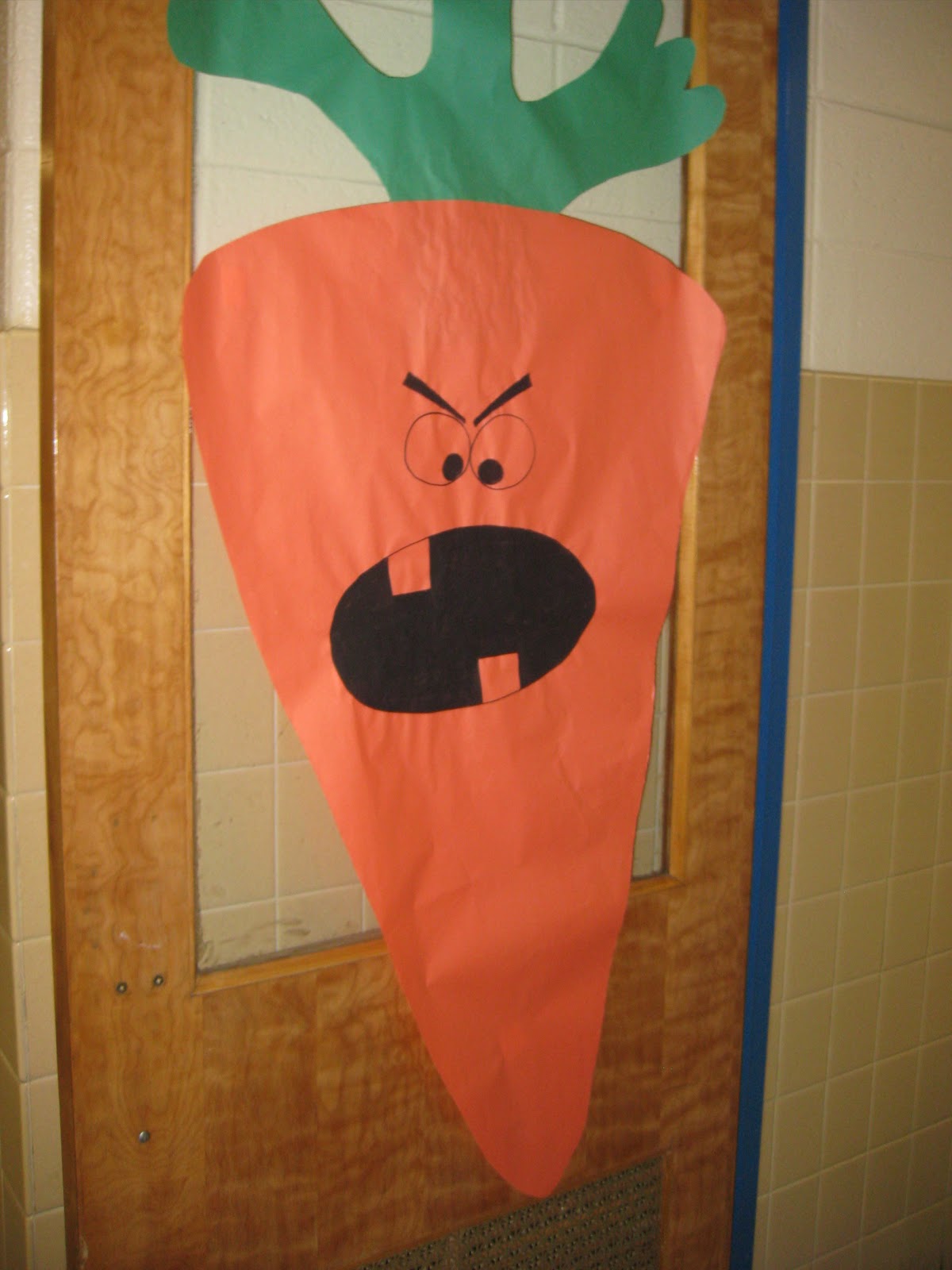
The weeks prior to Peter's visit we hung posters all over the school that announced his upcoming visit.  We included photos of Peter and his books.  Paper carrots were hung from the ceiling the week before to help generate excitement with our students and staff.  And of course we read his books!  Teachers also created many wonderful literacy activities to extend the books.


The morning of the event we greeted Peter in pink tutus and hair bows in honor of Lucy Bear, a favorite character. Yes!  The teachers all wore tutus.  We are a very enthusiastic group.


Peter did  3 separate presentations for each grade level.  We are a K-2 building.  Then he spend the entire afternoon greeting students and signing nearly 300 books!  His presentations were wonderful.  He had a great manner with the children and a terrific sense of humor.  Anyone that can keep nearly 150 kindergartners engaged for 45 minutes is a winner in my book!


Here's some comments I received from our students;

  • I loved the sound effects he put in the Creepy Carrots story.
  • His picture of his mommy was funny.  He gave her 6 fingers.
  • He draws horses good.
  • The first book he made was about his dog, Buffy. 
  • He wished his dog could climb trees.
  • The best was when he showed how to draw a creepy carrot!
  • Peter taught us what inspired means.
  • I laughed when he told us about a bird pooping on his head when he was on a date.
  • I liked when he showed us some parts of his new book, Mr. Tiger Goes Wild.
  • He wrote, "Don't Be Creepy!" in my book!
  • He was good.  I want him to come back again.
  • I loved when he signed my book.  I was excited.
  • I want to write books like Peter Brown.


Peter Brown inspired our entire school.  Throughout the day students brought him cards and books that they made for him.  Teachers shared with me how students were inspired to create books and artwork in the same style as Peter's.  It was a non-stop day for all, especially Peter.  He was kind and patient to all, and very generous with his time.  It was an unforgettable day at our school - one that we will treasure in our hearts forever.  Thank you Peter Brown for visiting, sharing your books, sharing yourself and connecting with our young students.

Please visit my class website to see more about what our second graders did after reading The Curious Garden.

Saturday, March 30, 2013

Reading Workshop: Conferring Challenges

As I have moved away from using only guided reading groups to conferring one to one with my second graders, I have realized how much work I had to do on my conferring technique. Being able to keep accurate records and notes has been a challenge. I have used all sorts of systems and rarely stuck with them for the whole year, and found myself forgetting to record and relying on my memory to remember what I had taught at our last conference! Over the last 3 years or so, I have used a 1 inch binder that had a section for each student. I have modified forms that I found in The CAFE Book by Joan Moser and Gail Boushey and Conferring: The Keystone of Reader's Workshop by Patrick Allen.  I am currently using experimenting with the Confer app on my ipad. I have also briefly tried Evernote. But I think I have been focusing on the wrong thing - keeping these records as helped me see my true weakness - the actual conference!

Here's what I think are my main problems;

Time management.  I often spend way too much time with one student. If I want to meet with students on a regular basis I need to be more efficient with my time. But this often leads to my second problem! As soon as I sit next to a student I start thinking, "Oh, I can't waste time, so lets get going!"  And this nagging rush, rush, rush feeling is always lurking and sometimes prevents me from really connecting with my young readers.

Figuring out what to teach. I'm often not sure what to teach, so I talk too much or I teach too much. I sometimes walk away from the conference not knowing what I actually taught and realize the student probably felt the same!

I know I am really great at modeling or explaining how to use reading strategies or skills in my whole group lessons. I have been thinking about how I can transfer this quality to my conferences. When I look back at conferences that I felt good about I realized it was because I immediately knew what the student was doing well and what I could teach them. I didn't get to to the stressed out stage of worrying about time or what to teach.

I am currently reading Conferring With Readers by Jennifer Serravallo (@JSerravallo) and Gravity Goldberg (@drgravityg). One thing that I have been thinking about and doing more of when I confer is the "research" phase of my conference. I am trying to observe my reader for a few moments and really think about what I see them doing. Are they staying focused, using their finger, using post its? I am also trying to make sure I open up our conference with a question that will allow me to continue my research. Here's some questions I have used recently that have helped me in my research phase. Would you like to share your post it notes? How are post it notes helping you understand your non-fiction? What are you thinking?  The last one often flusters many students and they immediately begin retelling the story.  So, sometimes I add, "what do you think of that?" referring to their retelling. It's just over the last couple of weeks that I have been paying close attention to the questions I ask - which has helped me reflect on my conferring technique.  I really think I might keep a list of opening questions or comments to help me out. Once I get the conversation going I usually can see what strategies they are trying pretty quick.

The other idea that Jennifer and Gravity suggest is creating a list of goals or strategies and skills you want students to learn during a unit of study. While I do this in my head I really think this could help me to focus more during my conferences when it's time to identify a skill to teach. After spring break I plan on doing this for the remainder of our non-fiction unit.

I am only on Chapter 7, but I'm finding it so helpful as I work to improve my conferring. The authors do a great job of identifying the parts of a conference and even the different types of conferences. As I read it I realize I am doing many of these things, but I think naming them is so important if I want to keep doing them!

What challenges and successes have you had with your reading conferences?
Do you have a system for recording and keeping track of your conferences?

Wednesday, March 27, 2013

Non-Fiction Wednesday


In my effort to read more non-fiction to my second graders and find more non-fiction to add to my classroom library I am re-committing to participating in Kid Lit Frenzy's non-fiction challenge.  So be sure to click on over to see what everyone else is reading in the non-fiction picture book world.  Thanks to Alyson Beecher (@alybee930)  for always giving me more books to add to my TBR list!

Ocean Sunlight: How Tiny Plants Feed the Seas by Molly Bang & Penny Chisholm

The book explains the role of sunlight in Earth's food chain, with particular emphasis on plankton, the tiny microscopic plants and animals that provide food for the oceans animals and also produce half of Earth's oxygen. The text, told from the point of view of the Sun, is beautiful and has a lyrical quality. The illustrations are spectacular - I loved how Molly Bang illustration helped my students visualize the plankton multiplying. I read this book to my class recently and they loved it too. In fact, many had connections later as they found other books with similar topics like food chains and plankton. Sometimes non-fiction picture books are full of glorious pictures but miss the mark with the information piece - either dumbing down concepts or leaving the reader confused. but this book really delivers on the information by using proper vocabulary and explaining the concepts in such a meaningful way.

You may be aware of many of Molly Bang's Caldecott books, like When Sophie Gets angry - Really really Angry, but you should also check out her science books. You can see a list of Molly Bang's science books at her website. I can't wait to read them.

Stinging Scorpions by Natalie Lunis

Full of amazing up-close photographs of these scary little creatures, this informational book should be very popular in my classroom. I love that there is lots of features that will help my students successfully read non-fiction including headings, labels and a glossary. The text includes many vivid and gross parts that will appeal to many young readers, including the section titled "Tearing into a Meal".  I was so excited to discover this great series of non-fiction books called No Backbone! The World of Invertebrates published by Bearport Publishing. There are 6 books in the series that are perfect independent reads for my second graders. I think the publisher even has guiding reading levels for many of their books. I can't wait to add this collection to my class library.  They are all hardcover I think, so a bit more costly.  But we all know how paperbacks wear out so quickly.  Does Santa come in March?

Have you read any good non-fiction?
What non-fiction do your students like to read?


Monday, March 25, 2013

It's Monday! What are you reading?


Thanks to Teach Mentor Text blog for their weekly inspirational meme.  Here's highlights of what I read this week.

If You Hold a Seed by Elly MacKay

This beautifully illustrated picture book tells about the magic of planting a seed and patiently waiting to see what happens through the seasons and the years.  I first fell in love with the illustrations when I viewed the book trailer that highlights the process that Elly MacKay uses to create her illustrations.  The process gives the illustrations a three dimensional quality and adds a beautiful lighting to each illustration. I love the colors and the intricately drawn animals-especially the birds!


Seeds, Bees, Butterflies, and More! Written by Carol Gerber and illustrated by Eugene Yelchin

This collection of poems for two voices is perfect for spring. All the poems share the same theme - the interaction of plants and insects. I love how the seeds describe their journey in We Can Fly and Hitchhikers. Another of my favorites is when the bees describe pollination in Honey Bee Dance.  Each poem has illustrations that are brightly colored and each poem is packed with great vocabulary and personality.  And don't forget the added bonus of a science lesson too. The text uses 2 different colors to show the 2 separate voices so it's easy for the readers to follow along.  I can't wait to introduce this book to my second graders during Poetry Month.


Tell the Wolves I'm Home by Carol Rifka Brunt

What first drew me to the book was the fact that it takes place in 1987.  Although I was a teenager in the 70's I was intrigued with the idea of traveling back to a time period that I was familiar with and seeing it from a 14 year old's point of view.

Fourteen year old June has a very close relationship with her Uncle Finn, who has AIDS.  Once Finn dies June slowly begins to learn the truth about Finn, his boyfriend Toby, and her family.  I loved the journey June goes on as she mourns the loss of her uncle. This is not a story about AIDS or what it was like to be gay in the 80's.  It is a story about family, loss, jealousy, forgiveness, and most of all - love.  June knows very little about her uncle's "friend" and blames him at first for Finn's death.  June meets Toby secretly and forms a friendship with him.  June's love for her uncle allows her to question what she has been told and what she thinks about her uncles life, illness and friend.

Sibling relationships are a strong part of the story and were particularly moving to me, as one of three sisters myself.  June's relationship with her older sister, Greta, is complicated - just like real life.  Her sister is mean to the point of being cruel to June at some points, and June wonders why.  June is also mourning the loss of the strong friendship and closeness she once shared with her sister, and can't understand why things have changed.  As the story unfolds June also explores the sibling relationship between her mother and uncle, Finn.  She slowly begins to see the pain, loss and grief behind everyone's anger - even her own.

I really loved this book and wish I could tell you the part where I cried and had to read the book aloud for awhile - but I don't want to spoil the book for you!

So, what are you reading?


Monday, March 11, 2013

It's Monday! What are you reading?


Thanks to Teach Mentor Text blog for their weekly inspirational meme.  Here's what I read this week.

Lincoln's Grave Robbers by Steve Sheinkin

I couldn't put this book down. It's sort of a combination history and mystery. It's the true story of the attempt to steal Abraham Lincoln's body from his tomb in Springfield, Illinois.

You had me at Lincoln! Since I was a little girl growing up in Illinois I have had an avid interest in Abraham Lincoln. (You know Illinois is the Land of Lincoln, and don't even get me started on my love of the penny.)

Steve Sheinkin has done some fine research for this novel. He is able to weave together a suspenseful story that doesn't let up until the end. The book reads like a novel, and I think fans of both fiction and non-fiction will enjoy it. It is considered in the young adult category, but I think it could make a great read aloud for 5th or 6th grade too.

Steve Sheinkin's book Bomb: The Race to Build - and Steal the World's Most Dangerous Weapon will definitely be rising to the top of my TBR pile!

This week I continued to make my way through the Lunch Lady graphic series and have also read a couple more Frannie K. Stein books before I add them to my class library. They are very popular with my second graders this year. I really need to bump up my kid lit non-fiction reading too!

That's it for this week. What are you reading?

Sunday, March 10, 2013

Writing About Reading

This weekend I had the pleasure of attending the Saturday Reunion at Teachers College Reading and Writing Project. There were so many wonderful presenters and I left feeling inspired and wishing I could have attended more workshops!


I want to use this post to reflect on a workshop I attended that was presented by Kathy Collins, the amazing author of Growing Readers and Reading for Real. Kathy's workshop was titled "Imagining the Possibilities of Reading Notebooks" and was geared for the grade 2/3 classroom. When I read the program in the morning I thought the topic was so timely because I had recently been thinking about the ways that I ask my second graders to respond or write about their reading.  In fact, I had read a recent post that Deb Frazier had wrote on her blog, Primary Perspectives, regarding her own reflections on using a reading notebook in her 1st grade class.

So here's what I learned and reflected on while Kathy spoke this weekend.

What is the purpose?  How does it help students?  How does it help me?
Kathy asked, "Why are we writing about our reading?" Is it for assessment or data collection? Is writing used to get closer to the text or in preparation of talk? Which are authentic reasons? Which are for the students and which are for us?

Reflections: Why do I do it? I want my students to stop and think about their reading.  I can tell my students that good readers think while they read and I can model through think aloud, but students often need a little help when they start doing this thinking on their own.  Post It notes are a simple and fun tool that help students "capture their thinking" as Kathy says and help me understand them as readers.  It helps them dig deeper and improve critical thinking. When students jot down their thoughts about a book it's helping them get ready to share or talk about their reading. Post Its are a way for my students to hold on to their thoughts and ideas quickly and easily.  Why do I do the other types of writing? You know - responding to a question or prompt about a book or story?  I do that because of the tests my students will start taking in 3rd grade.  But I don't think I need to turn every book we read into an assignment.  I would prefer to create readers and book lovers, and I know I do that by giving my students plenty of time to read books that they choose for themselves.

Just writing those words down helped free me from this nagging voice that kept telling me I needed to do more "assignments" after books are finished.  Note to self:  Kids first, tests last.

Do all writers have a point of entry?
Kathy talked about differentiating 'writing about reading'. Do all students have access to the types of 'writing about reading' you do in your class?

Reflection: I love Post It notes and expect my students to use them.  But I have to admit I have a handful of students that don't use them or use them inappropriately.  You know the kids - they are the ones that are a bit disorganized or inattentive.  With these students I find myself reteaching, remodeling and reminding them OFTEN to use Post It notes.  They often look at me with a blank stare, and mutter the words, "I forgot."  I have been frustrated with this group of students, and I am embarrassed to admit most of my time has been spent trying to get them to do the Post Its instead of thinking that this might not be the right tool for these readers.  Perhaps a big, yet simple graphic organizer would be easier for these students.  As a primary teacher, we also have students that may have strong responses to the text they read, but struggle with the mechanical part of writing.  How can I engage these students and help them respond to their reading in deeper ways?  Providing more choice, like drawing, might be the answer. (And don't forget the student who prefers to use the Post Its to make little airplanes or draw little cartoons.)

When does this writing happen? Kathy says It shouldn't take up too much reading time! And I agree.

Reflection: This has been a worry of mine.  When would I find the time to add something else? And how would I find the time to respond or "check" their work?  Other than all the Post Its we use daily as we read, do I need to make time once a week for writing about our reading?  Kathy calls these appointments for writing about our reading, and she says it needn't be more than 5 minutes at the end of reading workshop. (Hmm.. Takes that long for my kids to find their pencils)

In my mind I sort of divide writing about reading into 2 categories. The first type is the 'jot it down while its fresh in your mind' type. This is where I use Post It notes, but you could also use a graphic organizer or notebook. The second type is the 'after reading response' where readers process their thinking, and put it together to come up with the big ideas. But I realized I hardly give my students enough opportunities for that after the book thinking and talking!  Perhaps I need to do this more often, especially if I expect my second graders to develop critical thinking.

While Post It notes have been helpful to both my students and me, I don't get a chance to read most of them. When I confer they do share them with me, but what happens to the rest of them?  How could I improve the way I use their Post Its and other writing to help me know them as readers?  I realize I also need to build in some type of sharing for their 'writing about reading' and it all doesn't have to be with me.  I think Partner Reading is a good place for this sharing, so I need to explore this idea.

Kathy talked about figuring out which system works best for you. For her, she starts with a uniform approach, then watches to see who struggles or has difficulty with the Post Its.  She then introduces other ways to 'write about reading' as needed.

What can I bring to the mix?  What changes can I make?

I've gotten away from graphic organizers recently, probably because of all those cute and colorful Post It notes.  But I think I need to start bringing them back, keep samples hung up and even give students a chance to choose which one they want to use.  I also think I need to let students sketch about their reading more too.  A couple of years ago I did try using reading notebooks and gave students a list of open ended prompts to get them started.  But I felt it took too much time away from actual reading.

Kathy said we provide mentor texts for other types of writing so we need to do the same for 'writing about reading'.  Why didn't I think of this?  Sure, I modeled how to use Post Its, but if I look at my students' writing about their reading, the quality is often very poor and doesn't go beyond retelling, a prediction or a feeling.  I need to start treating this writing like other types of writing! I need to model and provide visual samples of my Post It thinking and any other writing we do about our reading.

So, where do I go from here? Will I use a reading notebook? I'm not sure yet! I am sure that all my students will have opportunities to write about their reading in a way that works for each individual student. Today's workshop helped me to focus on my purpose and being versatile in the ways my students respond.

Do you use a reading notebook?  What are your thoughts on Writing About Reading?
How about all those Post It notes?  What do you do with all of them?